TPU Materials — Fabric Solutions

TPU Coating &
Lamination
on Fabrics

High-performance thermoplastic polyurethane coating and lamination systems applied directly onto woven, knitted, and technical fabrics — delivering waterproofing, UV resistance, chemical protection, and weldability for industrial, automotive, marine, and outdoor applications.

3
Layer Options
0.5–2.0 mm
Thickness Range
HF
Weldable
Custom
Width & Weight
Scroll
Product

Technical fabric
engineered to perform

Our TPU-coated and laminated fabrics combine the mechanical strength of woven or knitted base textiles with the exceptional barrier, flexibility, and weldability properties of thermoplastic polyurethane — in a single composite material ready for fabrication.

Available in 1-layer, 2-layer (fabric + TPU film), and 3-layer (TPU / fabric / TPU) constructions, the fabrics can be supplied in thicknesses from 0.5 mm to 2.0 mm and in custom widths up to 2000 mm. The TPU surface is UV-stable, chemically resistant, and fully compatible with high-frequency (HF) welding, hot-air bonding, and heat sealing — enabling watertight seam construction without stitching. Applications include inflatable structures, protective covers, industrial curtains, survival equipment, flexible tanks, and automotive interior components.

Waterproof UV Resistant HF Weldable Chemical Resistant 1 / 2 / 3 Layer Options 0.5 mm – 2.0 mm Custom Width SGS Certified RoHS Compliant
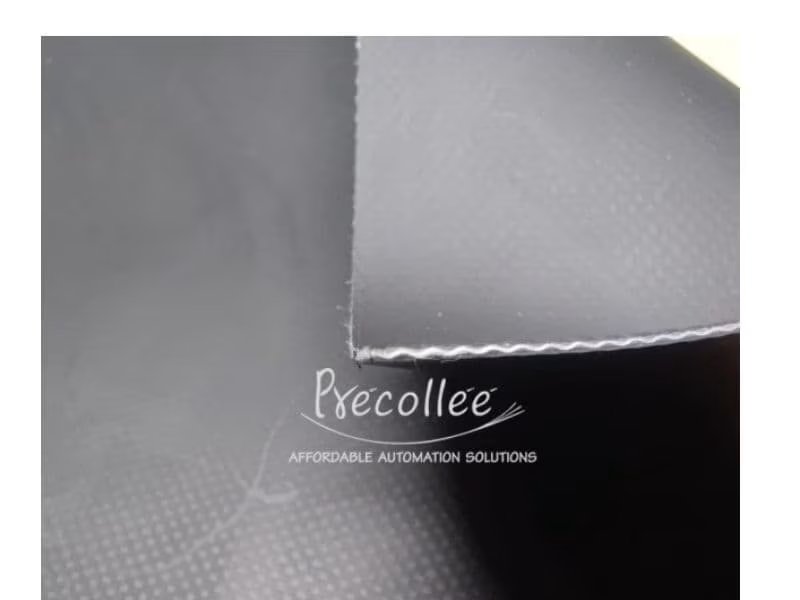
TPU laminated fabric
3-Layer TPU Laminated Construction
TPU film · Polyester fabric · TPU film
3L
Max Layer Construction
0.5 – 2.0 mm
Thickness Range
200 – 1800 g/m²
Weight Range (GSM)
Up to 2000 mm
Max Roll Width
Fabric roll
Roll-Form Supply
Custom width & length on request
Automotive application
Weldable & Sewable
HF welding · Hot air · Heat seal
Why Choose It

Six properties that set
our TPU fabrics apart

Every TPU-coated and laminated fabric from Precollee is formulated for the demands of industrial fabrication — combining weather resistance, mechanical durability, and seamless weldability into a single composite that replaces heavier PVC alternatives without compromising performance.
Fully Waterproof
The continuous TPU coating forms a seamless, pin-hole free barrier against water penetration. Combined with HF-welded seams, finished products achieve complete waterproofing — critical for inflatable boats, survival suits, tarpaulins, and flexible tanks.
UV & Weather Resistance
Stabilised TPU formulation resists UV degradation, ozone attack, and extreme temperatures from –40°C to +80°C — maintaining colour, flexibility, and mechanical properties across years of outdoor exposure without cracking or chalking.
HF Weldable
The TPU surface responds to high-frequency (dielectric) welding, hot-air bonding, and heat sealing — enabling watertight, high-strength seam construction without stitching. Essential for inflatable structures, chemical containers, and medical devices.
Chemical Resistance
Resistant to oils, fuels, dilute acids, alkalis, and many industrial solvents — making it the material of choice for chemical storage liners, spill containment products, protective clothing, and industrial curtains in harsh environments.
Multi-Layer Construction
1-layer (single-side TPU coating), 2-layer (TPU film laminated onto fabric), and 3-layer (TPU / fabric / TPU sandwich) constructions available — each offering a different balance of weight, stiffness, and barrier performance for the application.
Custom Specification
Base fabric (polyester, nylon, glass fibre), TPU hardness, thickness, GSM, colour, and roll width all configurable. Precollee engineers the composite to match your fabrication process and end-product performance requirements.
Construction & Process

How TPU lamination is built

01
Select the Base Fabric
The reinforcement layer is selected based on tensile, tear, and dimensional stability requirements. Standard options include 500D–1000D polyester plain weave, high-tenacity nylon, and glass fibre — each offering different strength-to-weight ratios for the target application.
02
Choose the Layer Construction
1-layer coating applies TPU directly onto one face of the fabric for lightweight barrier applications. 2-layer lamination bonds a pre-cast TPU film onto the fabric for superior surface quality. 3-layer sandwiches the fabric between two TPU films for full encapsulation, maximum barrier performance, and double-sided weldability.
03
Lamination & Coating
TPU is applied using calendar coating or film lamination under controlled heat and pressure. The process bonds the polymer into the interstices of the fabric weave, creating a composite with no delamination under flex or tension. Coating weight (GSM) is controlled precisely to achieve the specified thickness and performance profile.
04
Testing & Supply
Finished fabric is tested for tensile strength, tear strength, waterproofness (hydrostatic head), peel adhesion between layers, and UV resistance. Rolls are supplied in standard and custom widths up to 2000 mm, with batch test certificates available on request. Custom colours and surface embossing available for OEM programs.
TPU lamination process
TPU Fabric at a Glance
3 Types
Constructions
0.5mm+
Min Thickness
HF
Weldable
Custom
GSM / Width
Technical Data

Product Grades & Specifications

Data represents typical production values. Independent testing recommended for your application. Custom base fabric, TPU hardness, thickness, and width manufactured to your specification on request.
PRL-TPU-2L
2-Layer
Construction
TPU Film + Fabric
Thickness
0.8 – 1.2 mm
Weight (GSM)
450 – 900 g/m²
Surface
Film-quality TPU face
Pre-cast TPU film laminated onto woven fabric. Superior surface finish for inflatables, survival suits, and flexible ducting.
PRL-TPU-3L
3-Layer
Construction
TPU / Fabric / TPU
Thickness
1.0 – 2.0 mm
Weight (GSM)
900 – 1800 g/m²
Surface
Dual-side TPU
Full fabric encapsulation in TPU. Maximum barrier, double-side weldability. For boats, tanks, chemical liners, and heavy industrial covers.
Property PRL-TPU-1L
1-Layer
PRL-TPU-2L
2-Layer
PRL-TPU-3L
3-Layer
Notes
Base Fabric 500D Polyester 500D–1000D Polyester 500D–1000D Polyester / Nylon Custom base fabric available
Total Thickness 0.5 – 0.8 mm 0.8 – 1.2 mm 1.0 – 2.0 mm Per ISO 2286-3
Weight (GSM) 200 – 450 g/m² 450 – 900 g/m² 900 – 1800 g/m² Per ISO 2286-2
Tensile Strength ≥ 800 N/5cm ≥ 1500 N/5cm ≥ 2000 N/5cm Warp & weft, ISO 1421
Tear Strength ≥ 80 N ≥ 150 N ≥ 200 N Trapezoid, ISO 4674
Hydrostatic Head ≥ 3000 mm H₂O ≥ 8000 mm H₂O ≥ 15000 mm H₂O ISO 811
HF Weldable ✓ Yes ✓ Yes ✓ Yes Hot-air & heat-seal compatible
UV Resistance Good Excellent Excellent Stabilised TPU formulation
Temperature Range –30°C to +70°C –40°C to +80°C –40°C to +80°C In-service operating range
Chemical Resistance Oils, dilute acids Oils, fuels, acids, alkalis Oils, fuels, acids, alkalis, solvents Specific resistance chart on request
Max Roll Width Up to 1500 mm Up to 2000 mm Up to 2000 mm Custom widths available
Colours Standard + Custom Standard + Custom Standard + Custom RAL colours for OEM programs
RoHS Compliance ✓ Compliant ✓ Compliant ✓ Compliant EU RoHS 2011/65/EU
Certification SGS Certified SGS Certified SGS Certified Batch test reports available
Remarks
  1. Mechanical data represents typical production values for standard polyester base constructions. Values vary based on base fabric denier, weave density, and coating weight — request a specific datasheet for your configuration.
  2. Custom base fabrics (nylon, glass fibre, polyester blend), TPU hardness grades (60A–95A), surface emboss patterns, and colours manufactured to order. Minimum order quantities apply — contact our team for details.
  3. Test reports, material safety data sheets, and compliance declarations available for all grades on request.
SGS Certified
RoHS Compliant
HF Weldable
Make in India
Custom Width Available
Use Cases

Where our
TPU fabrics perform

From inflatable rescue boats and flexible chemical storage tanks to automotive interior panels and architectural membrane structures, Precollee TPU-laminated fabrics are specified wherever a lightweight, waterproof, and weldable technical composite is required — without the weight or environmental concerns of PVC alternatives.
Marine & Inflatables
Marine & Inflatable Structures
Inflatable rescue boats, RIBs, kayaks, life rafts, air tents, and industrial air beams — the 3-layer construction delivers the weld-strength and pressure resistance required for safety-critical inflatable products.
Industrial
Flexible Tanks & Liners
Collapsible water, fuel, and chemical storage tanks for military, agricultural, and industrial use — where chemical resistance and weldability are critical.
Automotive Interiors
Door panel inserts, headliners, seat bolsters, and trunk liners — the 1-layer construction delivers a premium surface at low weight for OEM interior trim.
Protective Clothing & Suits
Chemical protective suits, survival suits, and hazmat outerwear where full encapsulation and welded seams are mandatory for operator safety.
Industrial Covers & Curtains
Machine guards, warehouse curtains, acoustic barriers, and outdoor industrial covers requiring UV stability, weather resistance, and long service life.
FAQ

Common questions answered

TPU fabric
What is the difference between TPU coating and TPU lamination?
+
TPU coating (1-layer) applies a layer of TPU polymer directly onto the fabric surface using a calendar or knife-over-roll process — the polymer penetrates into the fabric weave creating a fused composite. TPU lamination (2-layer, 3-layer) bonds a separately pre-cast TPU film onto the fabric using heat and pressure — giving a smoother, more consistent surface finish and higher peel strength between layers. Laminated constructions typically offer better waterproofness and aesthetics; coated constructions offer lower cost for less demanding applications.
Can the fabric be welded using high-frequency (HF) equipment?
+
Yes. All three construction grades are fully compatible with high-frequency (dielectric) welding. The TPU surface absorbs RF energy and melts at the weld interface, creating a seam that is typically stronger than the fabric itself. The 3-layer construction is particularly suited for HF welding as both faces carry a clean TPU surface. Hot-air welding and heat-seal tape bonding are also compatible for all grades.
What base fabrics are available?
+
Standard production uses 500D and 1000D high-tenacity polyester plain weave. Nylon (polyamide) base fabrics are available for applications requiring higher abrasion resistance or lighter weight at the same strength. Glass fibre reinforcement is available for dimensional stability and temperature resistance applications. Custom denier, weave pattern, and yarn type can be specified for OEM programs — share your strength and weight requirements and we will recommend a base construction.
Is the TPU fabric a suitable alternative to PVC-coated fabric?
+
For most applications, yes. TPU-laminated fabric outperforms PVC in flexibility at low temperatures (TPU remains flexible below –30°C where PVC stiffens), UV resistance without plasticiser migration, chemical resistance to fuels and oils, weldability, and environmental profile (TPU is halogen-free, phthalate-free, and recyclable). The primary trade-off is cost — TPU fabrics carry a higher unit price than PVC for equivalent construction weight, but offer a longer service life that improves whole-of-life economics.
What custom options are available?
+
We can customise base fabric type and denier, TPU hardness (60A–95A Shore), coating weight and thickness, roll width (up to 2000 mm), colour (including RAL matching for OEM programs), and surface finish (smooth, matte, embossed). Printed branding and reflective strip lamination are available for safety and branded products. Please provide your application requirements and target performance specifications and our team will prepare a custom sample program.

Ready to specify your
TPU laminated fabric?

1-layer, 2-layer, and 3-layer TPU fabric available in standard and custom configurations. Request a sample roll and our team will work with you to define the right construction, thickness, and base fabric for your fabrication process.

SGS Certified
RoHS Compliant
HF Weldable
Make in India
Premnath +91 90808 72036
Hariharan +91 83444 56565
ragothaman@precollee.com

Stay ahead with new material updates

Product launches, technical datasheets, and industry insights — delivered to your inbox.